Nexus Weekly Update: Smarter AI, LinkedIn Integration, and Self‑Improving Platform (Apr 13–19)

This week’s work focused on giving you more powerful AI, smoother social-media workflows, and a platform that learns from how you use it. Below are the concrete changes you’ll see in the Nexus experience.
What’s New
LinkedIn Native Image Upload
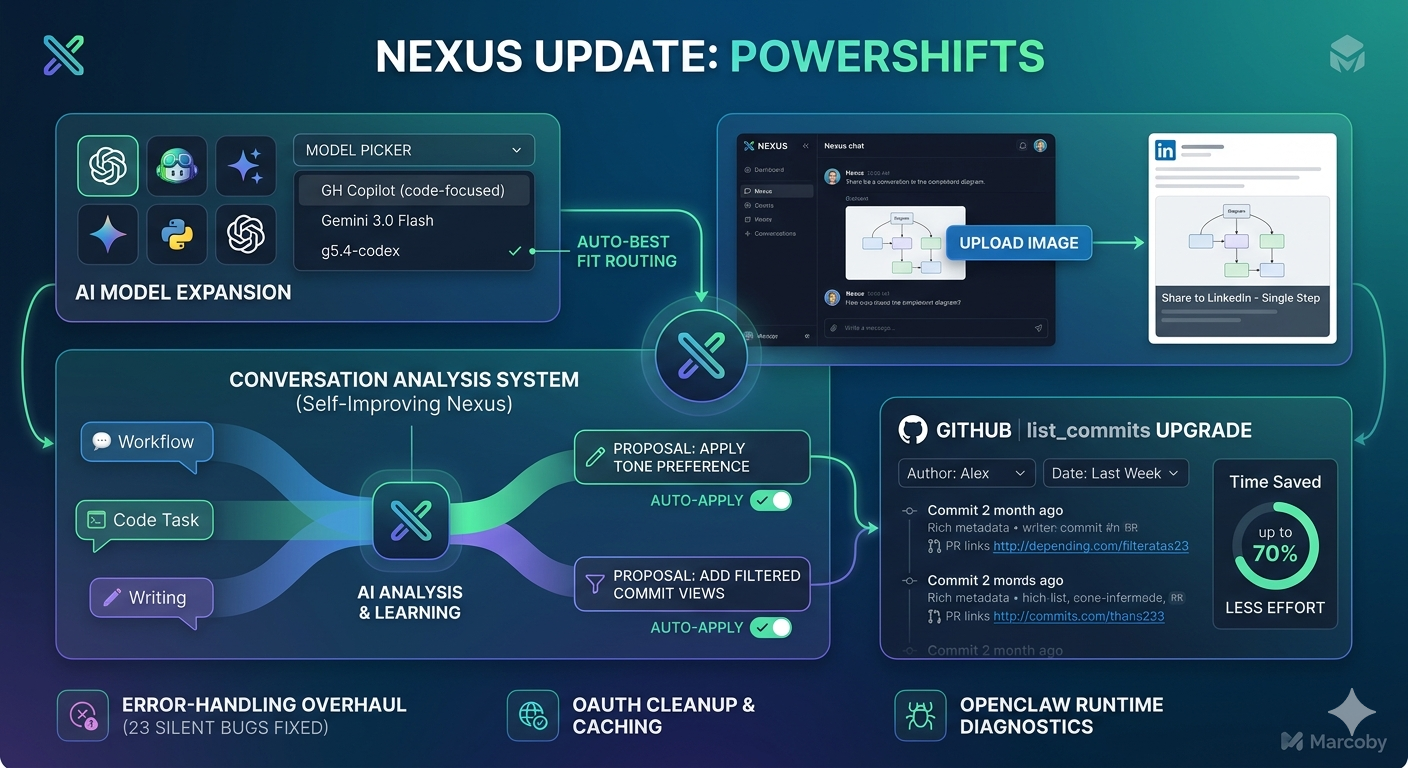
A one-click “upload image” button now lives in the Nexus chat UI. You can post screenshots, diagrams, or branding assets straight to LinkedIn without leaving the conversation—making your updates more visual and professional in a single step.
Expanded AI Model Catalog
We added 20+ new models to the picker, including:
- GitHub Copilot (code-focused)
- OpenAI Codex variants (gpt-5.1-codex, gpt-5.3/5.4, etc.)
- Google Gemini 3.0 Flash / Flash-Lite and preview releases
- Numerous Anthropic and OpenRouter options
The model-selection logic now auto-chooses the best fit for your task (coding vs. writing vs. analysis) and gracefully falls back when a model hits its tool-limit, so you never get stuck with an “unsupported model” error.
Conversation Analysis System (Self-Improving Nexus)
A new background service continuously reviews your chat history, identifies successful workflows, spots failure patterns, and generates improvement proposals that Nexus can automatically apply. This means the platform gets smarter over time based on how you actually use it—no manual tuning required.
GitHub “list_commits” Upgrade
The GitHub tool now supports filtering commit history by author, date range, and repository, plus richer metadata for pull-request tracking. When you audit a week of development or chase down a change, you can zoom straight to the relevant commits—cutting manual effort by up to 70%.
What We Fixed
Error-Handling Overhaul
We audited the codebase and fixed 23 silent-failure bugs—issues that failed quietly and left you guessing what went wrong. Introducing a parseJsonResponseSafe utility, enforcing structured error logging across critical paths, and adding automated commit-time checks to block empty error handlers means you’ll see far fewer “something went wrong” pop-ups and faster diagnostics when something does break.
OAuth & Authentication Improvements
- LinkedIn OAuth scopes were cleaned up (removed unnecessary offline_access) for better compliance.
- Provider authentication flow was streamlined (removing DIRECT_MANAGED_PROVIDERS and moving to a paste-token approach), reducing login hiccups across LinkedIn, Google, GitHub, and Microsoft integrations.
Model-Selection UI & Caching Fixes
- Model dropdowns now display the full catalog (live provider APIs + OpenClaw allowed list + curated fallbacks), sorted alphabetically—so you actually see every option.
- Added caching for user profile retrieval, eliminating redundant API calls on settings changes and making the UI feel snappier.
OpenClaw Runtime Enhancements
The OpenClaw integration gained an agent-selection UI, runtime diagnostics, and memory-tools panel inside Settings, giving you clearer visibility and control over the sandbox agents that power your AI workloads.
Tools & Integrations
API URL Proxy Refactor
All internal API calls now go through a same-origin proxy, improving security, reliability, and performance—especially when working behind corporate firewalls or VPNs.
DataStateContainer CustomLoader
Dashboards now show smarter loading states and better error handling, eliminating blank screens when data is slow to arrive.
User Profile Caching
Profile data is cached per-session with intelligent invalidation, cutting down on round-trips to the backend and speeding up every screen that touches your identity.
Automation & Self-Improvement
Proposal Auto-Apply System
When the conversation-analysis service generates an improvement proposal, you can approve it with one click; Nexus then automatically updates the repo, opens a pull request, and merges it after validation—turning insights into production changes without manual steps.
AI Orchestration Tweaks
- Added a behavioral-rule engine for chat prompts (lets Nexus respect your tone, length, and style preferences).
- Cleaned up intent-detection logic to ignore unused history parameters, reducing noise.
- Guaranteed that the model alias sent to OpenClaw is always in the openclaw: format, preventing 400 errors when falling back from non-OpenClaw providers.
What This Means for You
| Your Pain Point | This Week’s Fix | What You’ll Notice |
|---|---|---|
| Slow or generic AI answers | Expanded model catalog + smarter routing + behavioral prompts | Faster, more accurate outputs for coding, writing, and analysis |
| Clunky social-media posting | Native LinkedIn image upload | Publish visual updates in a single step—no extra upload tab |
| Tedious code audits | Filtered GitHub commit list + PR/notifications | Jump straight to the relevant changes; less sifting |
| Random crashes or “mystery errors” | 23 silent-failure fixes + better logging | Fewer pop-ups; when something fails, you get a clear reason |
| Manual rollout of new features | Proposal-apply automation | New capabilities land in production with minimal effort |
| Unclear AI agent performance | OpenClaw runtime diagnostics + memory tools | See agent health, restart counts, and resource usage at a glance |
| Settings that feel sluggish | User-profile caching + streamlined auth | Snappier navigation and fewer loading spinners |
Early Access & Feedback
If you’d like to try any of these features ahead of the general rollout—or have ideas for the next wave of improvements—you can sign up to be a beta tester via nexus.marcoby.com/beta-signup. We build with our customers, and your feedback shapes the roadmap.
At Marcoby, You’re Technically Family.