What Does "I Want a Website" Really Mean?
Most business owners say "I want a website" when what they really need is something more specific. Here's how to figure out what you actually need — without the jargon, the overwhelm, or the $10,000 invoice.

Every few weeks, I get a call or a message from a business owner who says some version of the same thing: "I need a website."
And every time, what they really mean is something a little different. Sometimes they mean "I need people to find me online." Sometimes they mean "my competitor has a website and I don't, and it's costing me jobs." Sometimes they mean "I have a website but it doesn't do anything — it just sits there."
None of those are wrong. But if you jump straight to building a website without figuring out which one you actually need, you end up spending money on something that doesn't solve the real problem. That's how small businesses end up with a $3,000 digital brochure that nobody visits.
So let's slow down and talk about what "I want a website" actually means — and how to think about it without getting overwhelmed.
The Four Things People Actually Mean
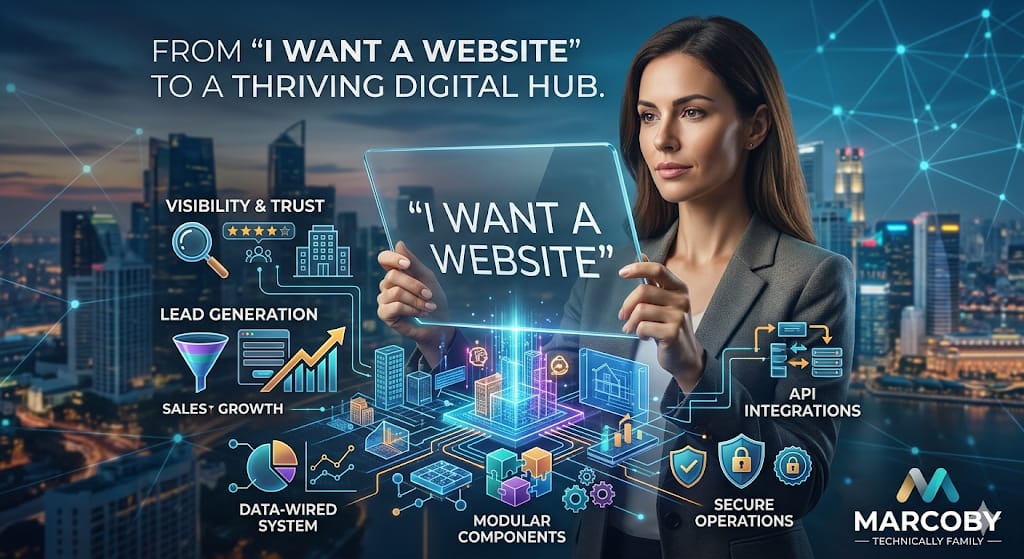
After doing this for a while, I've found that almost every website project falls into one of four buckets. You might need more than one, but starting with the primary one keeps you focused and keeps costs sane.
1. "I need to be findable."
This is the most common one. You do great work, your customers love you, but new people can't find you. They Google something like "IT support near me" or "website hosting Fontana" and your name doesn't show up. Your competitor's does.
Being findable isn't just about having a website — it's about having a website that search engines can actually read, with the right information in the right places. That means a real domain name (not a free Wix subdomain), a site that loads fast, and content that answers the questions your customers are already asking.
If this is where you are, you don't need a fancy website. You need a clean, fast, well-structured one. And you need it indexed on Google. That's it.
2. "I'm losing leads I should be catching."
You've got traffic — maybe from word of mouth, maybe from social media, maybe from a Google Business Profile listing. People are finding you. But they're not sticking around. They land on your page, look around for ten seconds, and leave.
That usually means one of a few things: your site doesn't clearly say what you do, there's no obvious next step (no phone number, no contact form, no "book a call" button), or it looks so outdated that people assume you might be out of business.
This is a trust problem, not a technology problem. The fix is usually straightforward: tighten up your homepage copy, make sure your contact info is impossible to miss, and update the design enough that it looks like someone is home.
3. "I want to look legit."
This one matters more than most business owners think. You might not care about aesthetics, but your customers do. When someone is deciding between two businesses and one has a clean, professional-looking website and the other has a Facebook page from 2019 — they're calling the first one.
Looking legitimate doesn't mean having an award-winning design. It means having a site that loads without errors, looks consistent across phone and desktop, has real photos (not just stock images), and clearly communicates who you are, what you do, and where you do it.
This is especially important for service businesses. People are inviting you into their home or office or trusting you with their data. They're going to look you up before they call. Make sure what they find gives them a reason to pick up the phone.
4. "I want to grow."
This is the most ambitious version — and honestly, the most exciting. You're not just looking for a digital business card. You want a platform. A place to publish content, collect leads, maybe sell something, maybe build a community. You want the website to actually do something for your business beyond just existing.
This is where things like analytics, CRM integration, email capture, and regular content come in. It's also where the conversation gets fun, because now we're not just building a website — we're building a system that compounds.
But here's the thing: you don't have to start here. Most of the businesses I work with start with one of the first three and grow into this one over time. That's completely fine. That's actually the smart way to do it.
Okay, So What Do I Actually Need?
If you're not sure which bucket you fall into, here are the questions I'd ask you over coffee:
- What happens when someone Googles what you do? Do you show up? Does your site come up? Or does nothing happen?
- When someone lands on your site, what do you want them to do? Call you? Fill out a form? Read something? Buy something? If the answer is "I don't know," that's the first thing to figure out.
- When was the last time you looked at your site on your phone? If it's broken, slow, or hard to read on mobile, half your potential customers are already gone.
- Does your website match the quality of your work? If you're great at what you do but your site looks like it was built in 2012, there's a gap. People notice.
- Do you have a domain name you own? Not a free subdomain, not a borrowed one — your own yourbusiness.com. If not, this is step zero.
These aren't trick questions. They're just starting points. And you don't have to answer all of them before you reach out. That's literally what we're here for.
The Parts of a Website (Without the Jargon)
I want to demystify this, because the tech side of websites has a reputation for being complicated. It can be — but it doesn't have to be. Here's what actually matters:
Your domain name. This is your address on the internet. yourbusiness.com. You should own it, not rent it. If someone else controls your domain, they control your online identity. We handle domain registration through Pulse so it's simple and it's yours.
Hosting. This is where your website lives. Think of it like renting office space, except it's on a server. Cheap hosting means slow load times and frequent downtime. Good hosting means your site is fast, secure, and available when someone Googles you at 11 PM. This matters more than most people realize — speed directly affects whether Google shows your site to anyone.
A way to manage content. You need to be able to update your own site without calling a developer every time you want to change a phone number or post a new article. That's what a CMS (content management system) does. We set clients up with tools that are actually easy to use — not clunky, not overwhelming.
Security. An SSL certificate (the little padlock in the browser bar) is table stakes. If your site doesn't have one, browsers literally warn visitors that your site isn't safe. We include this with every hosting setup because it should never be an afterthought.
Analytics. You need to know if anyone is visiting your site, what they're looking at, and where they came from. Google Analytics is free and powerful. We wire it up during launch so you're not flying blind from day one.
You Don't Have to Do This Alone
Here's what I really want you to take away from this: getting a website doesn't have to be a months-long, budget-breaking, headache-inducing ordeal. It used to be. It doesn't have to be anymore.
At Marcoby, we built Pulse specifically because we got tired of watching small business owners get taken advantage of by agencies that charge $10,000 for a template site, or get stuck with a GoDaddy page builder that looks like it was designed in a basement. You deserve better than that.
With Pulse, you can get started with a domain and hosting in minutes — and if you need more, like a full website build, we handle the whole thing. Strategy, design, development, launch, and the ongoing stuff that keeps it running. You focus on running your business. We make sure the digital side keeps up.
The businesses that are winning right now aren't the ones with the biggest budgets. They're the ones that showed up online — consistently, professionally, and with a clear message. That's accessible to every small business. You just need the right people in your corner.
Ready to Figure Out What You Actually Need?
You don't need to have it all figured out before you talk to us. Most of the time, a 15-minute conversation is enough to point you in the right direction — whether that's with us or not.
- Explore web hosting and website options on Pulse
- Book a no-pressure strategy call
- Or just head to pulse.marcoby.com and start poking around
At Marcoby, you're technically family. Let's build something that works.